Beyond The ZIP Code: How Location Affects Rental Demand
Rental demand is shaped by much more than the property itself as it can depend heavily on where that property is located. Two similar rental properties can produce very different results simply because they sit in different locations.
Rentability depends on whether a property matches the daily needs of the people likely to rent it. Employment centers, transportation, housing supply, and even the property’s position within a neighborhood can influence demand. For owners evaluating a rental, location should be examined through a tenant’s routine.
Below, you’ll discover how location affects rental demand and market information about comparable rents and neighborhood activity.
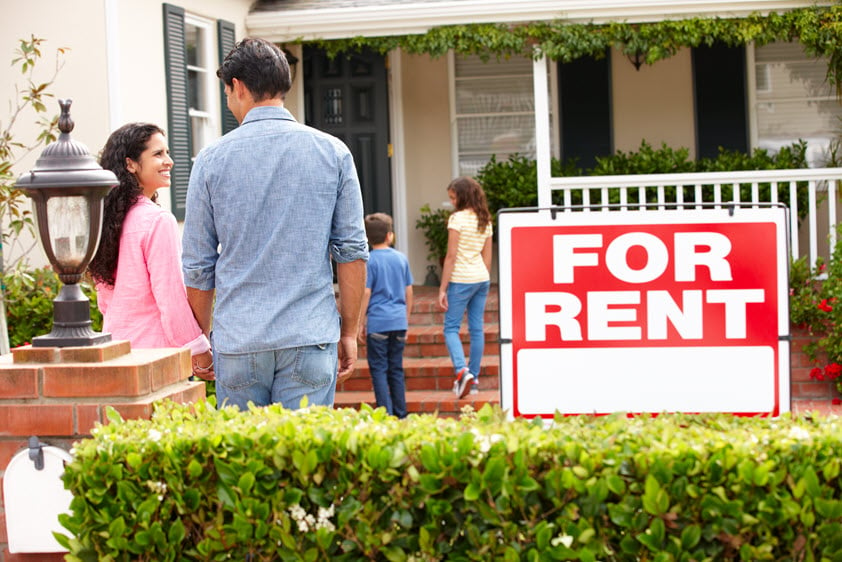
Rental demand: Employment and Transportation Drive Demand
A home may have desirable features and competitive pricing, but its location can determine how quickly it attracts tenants and how much rent it can command. Factors such as nearby jobs, schools, transportation, shopping, entertainment, and neighborhood appeal all influence what renters are looking for.
Understanding how location affects rental demand can help property owners and investors make smarter decisions and choose areas with stronger long-term potential.
Access to jobs is one of the strongest practical reasons people choose where to live. A property near a major employment center may attract workers who want a shorter commute. In other areas, easy access to highways or public transportation can matter more than physical distance.
Regarding rental demand, commute time deserves particular attention. A property may appear close to downtown on a map but require a difficult drive during peak hours. Conversely, a home farther away might offer a direct train or bus route that makes commuting easier.
Remote and hybrid work have changed this calculation for some renters. Extra space for a home office may carry greater value when tenants do not need to commute every day.
Everyday Convenience Can Affect Tenant Interest
Renters also consider what happens after work. Grocery stores, healthcare facilities, parks, restaurants, and other frequently used services can make a location more practical.
The value of individual amenities varies by renter. Families may place greater weight on access to schools and recreation, while someone without a car may prioritize walkability and public transportation. Owners should therefore consider the likely renter population rather than assuming every nearby amenity adds equal value.

Look at the Block, Not Just the Neighborhood
Neighborhood-level statistics can hide major differences between individual properties. Noise, traffic, parking, lighting, neighboring buildings, and proximity to busy commercial areas can change within a few blocks.
Visiting at different times can reveal conditions that are easy to miss during a single showing. A quiet street in the afternoon may experience heavy commuter traffic in the morning or significant noise at night.
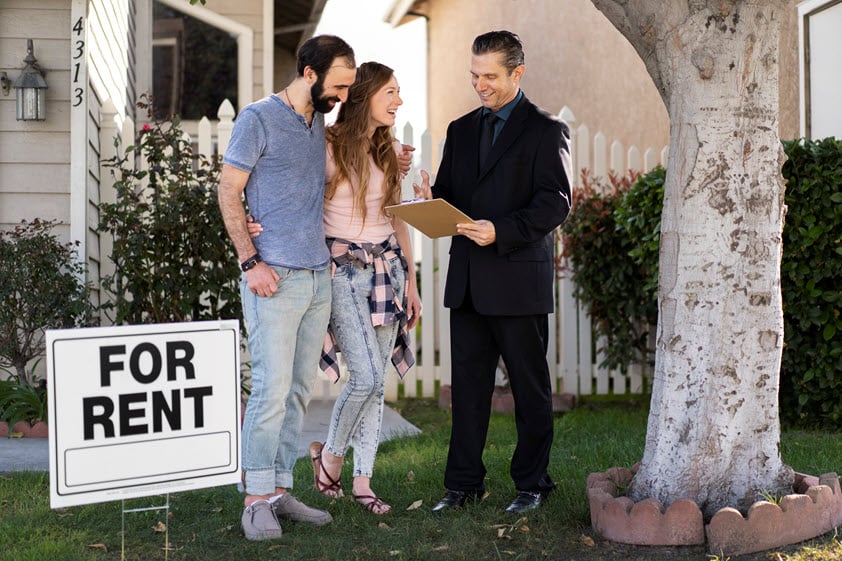
A local real estate company may provide market information about comparable rents and neighborhood activity, but owners should also examine actual rental listings and recent market conditions before estimating income.
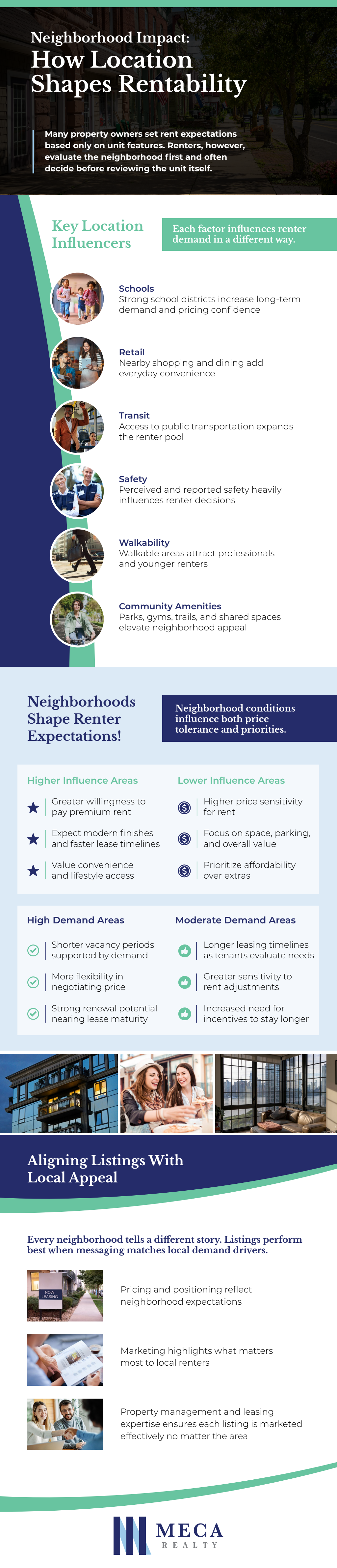
Location shapes rentability through a combination of demand, convenience, accessibility, and operating costs. Owners can make a stronger assessment by looking beyond broad labels such as “good neighborhood” and studying how people actually live there. Look over the infographic below for more information.